ORIGINAL ARTICLES
Background. Post-stroke rehabilitation is of great medical and social importance for stroke patients. Rehabilitation measures are aimed at restoring lost functions of the central nervous system, as well as early diagnosis and prevention of possible dysfunctions of organs and body systems after a stroke. Effective rehabilitation helps to reduce the degree of disability, maintain working capacity, and improve the quality of life for patients and their relatives.
Objective: To evaluate the effectiveness of rehabilitation treatment in patients during the early recovery period after ischemic stroke using standardized functional scales depending on the pathogenetic classification of strokes and lesion localization.
Material and methods. The study involved 57 patients aged 41 to 82 years with a diagnosis of ischemic stroke confirmed by neuroimaging data. The integral indices characterizing the clinical condition of patients before (on Day 1) and after (on Day 10) rehabilitation measures were dynamically assessed using functional scales and indices: Rehabilitation Routing Scale, Rivermead mobility index, Barthel Index for Activities of Daily Living, and modified Rankin Scale. In the middle of the study, on Days 6–7, the Functional Independence Measure was applied once. The Trial of ORG in Acute Stroke Treatment (TOAST) classification was used to distinguish stroke subtypes.
Results. Although the absolute values of changes in indices due to the limited duration of rehabilitation measures were relatively small, their positive dynamics was clearly observed. On Day 10 of rehabilitation treatment, reliable (p≤0.05) improvement was noted for all functional indices. More pronounced positive changes were noted in patients with atherothrombotic and cardioembolic stroke subtypes according to TOAST. Statistically significant positive dynamics of all studied indices was recorded in patients with brain lesions localized in vertebral and basilar arteries; less pronounced changes in indices were noted in carotid system. The dynamics of indices with lesion localization in the right and left middle cerebral arteries were equivalent. Thus, stage II rehabilitation measures showed comparable effectiveness in groups of patients distributed by both the pathogenetic subtype of stroke and localization of the brain lesion.
Conclusion. The method of assessing the rehabilitation potential of patients using functional scales is pathogenetically substantiated and can be used to predict rehabilitation, as well as to select and adjust an individual program of measures at the next (III) stage of medical rehabilitation.
REVIEW ARTICLES
Background. Total endoprosthesis, including total knee arthroplasty (ТКА), is the main treatment method for severe forms of osteoarthritis. However, the quality of life in patients after surgery largely depends on the management of the rehabilitation process. The development of new rehabilitation methods and a need to study the efficiency of traditional ones enhance the relevance of the systematization and analysis of new studies on ТКА rehabilitation.
Objective: to identify key trends in rehabilitation of ТКА patients and to consider current rehabilitation methods with proven efficiency.
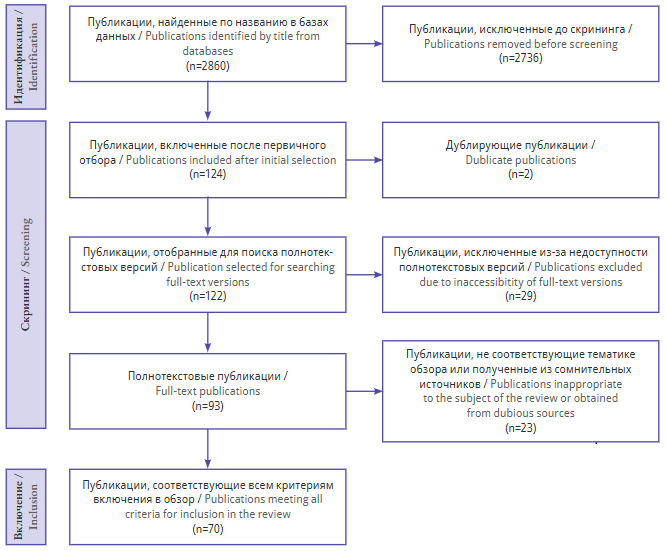
Material and methods. Literature search was conducted in scientific databases and electronic libraries: PubMed/MEDLINE, Google Schoolar, and eLibrary. A total of 2860 publications were identified, including 70 fully eligible and considered in the review. Sources were searched and selected based on PRISMA guidelines.
Results. The current trends in ТКА rehabilitation involve early initiation of recovery procedures, digitally managed late postoperative period, and a personalized approach. The use of proven methods ensures rehabilitation according to the specified trends. These include exercise, biofeedback, and physical (cryotherapy, neuromuscular electrical stimulation, and electroacupuncture) therapy, as well as the latest technologies: robotic exoskeletons and virtual reality devices. Specially designed mobile applications and remote monitoring tools enable efficient telerehabilitation. This personalized approach contributes to patients’ satisfaction with the recovery process.
Conclusion. The development of modern rehabilitation methods ensures comfortable recovery procedures for ТКА patients and their return to full life within a relatively short time.
Posterior communicating artery (PСоA) aneurysms represent a serious medical problem associated with a high risk of rupture leading to severe neurologic deficits, disability, and, in some cases, death. Despite the advances in microsurgical and endovascular treatment, the recovery of patients requires long-term, comprehensive, and multidisciplinary neurorehabilitation aimed at correcting motor, cognitive, and psychosocial disorders. The present review examines current approaches to rehabilitation, including early initiation, as well as the use of specialized scales and neuropsychological tests in combination with promising methods of hyperbaric oxygenation and neuromodulation. Particular attention is paid to artificial intelligence (AI) technologies in neurorehabilitation: the use of adaptive game systems, robotic exoskeletons, brain-computer interfaces, and gamification to personalize and increase the effectiveness of recovery programs. The integration of AI into the rehabilitation process opens up new opportunities for improving the functional outcomes and quality of life in patients with PСоA aneurysms. However, further research and a systematic approach in care management are required.
Non-specific low back pain (LBP) is one of the most common conditions that significantly affects a person's daily activities. Chronic LBP negatively impacts the quality of life of patients, often is accompanied by psychological complications and requires medical intervention with a lengthy rehabilitation program. This review studies the pathophysiological reasons underlying chronic LBP, presents a classification of rehabilitation methods, and evaluates effectiveness and safety of their use. Based on the summarized data from systematic reviews and meta-analyses, guidelines and recommendations for the management of patients with chronic LBP during rehabilitation are presented.
Balneotherapy is one of the oldest rehabilitation treatments, which has remained unchanged to date. The development of medical technologies, personalized approach and implementation of evidence-based medicine have led to reevaluation of balneotherapy and necessity to analyze its mechanisms. This review looks into specific applications of certain mineral waters, demonstrates the impact of mineral concentration of the water, its temperature, duration of balneotherapy session, as well as the presence of concomitant pathologies in patients on therapeutical effects or risks of adverse reactions.

This work is licensed under a Creative Commons Attribution-NonCommercial-ShareAlike 4.0 International License.
ISSN 2949-5881 (Online)